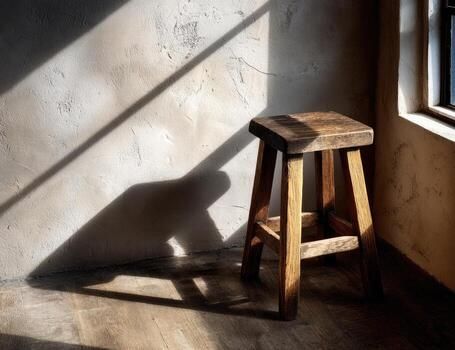
I should preface this by saying I once spent forty-five minutes debating whether to buy a wooden stool online at midnight, which is apparently the kind of profound spiritual crossroads my life has become these days.
But here’s the thing about that stool.
Gabor Maté writes in The Myth of Normal that “the most important question is not ‘what is wrong with you’ but ‘what happened to you’ — and what happened to you happened in relationship.” Everything, he argues, originates in connection. Not in isolation. Not in the clean, vacuum-sealed version of ourselves we prefer to present to the world, but in the messy, tangled, utterly unglamorous web of cause and effect that links us to people we’ll never meet, in places we’ll never visit, making decisions we’ll never know we influenced.
The tree that became my stool lived in a forest. Someone felled it — probably early, probably tired, probably thinking about something else entirely. Another person shaped it. Another person sold it. Their families ate dinner because of transactions I completed in my pajamas, mildly dissociating. The forest lost something. The animals reorganized. I now have somewhere to put my bag.
This is, quietly, terrifying.
Mindfulness teachers have been saying a version of this for centuries, though with considerably more equanimity than I’m currently managing. To be present — truly, deliberately present — is to accept that you are not, in fact, a self-contained unit moving through a neutral world. You are a pebble. The world is the pond. The ripples do not ask your permission.
An encouraging word to a child about their particular, awkward, specific gift can set a trajectory in motion that bends toward something none of us will live to see. A poem written at 2 a.m. because you had nowhere else to put the feeling can find its way to someone on the other side of the world who needed, desperately, to feel less alone. I know this because it has happened to me — someone else’s 2 a.m. became my lifeline. The author never knew. Probably still doesn’t.
We are, it turns out, ridiculously powerful. Not in the way we want to be. Not in the “corner office and a five-year plan” kind of power. In the quieter, more inconvenient, considerably harder-to-control way where the ordinary texture of our daily choices radiates outward into lives we cannot see and will never audit.
And yet.
Maté is equally clear — and here is where I find him most useful and most uncomfortable — that we are experts at severing ourselves from exactly this. Not dramatically. Not with full awareness. But with the particular, practiced efficiency of people who learned early that connection was dangerous, or disappointing, or simply too much to sustain.
He describes it as a kind of sleepwalking. You’re upright. You’re functional. You’re technically present at the meeting, the dinner table, the date, the moment. But the current that runs through living things — the one that moves between people and into the soil and back again — you’ve quietly stepped out of it. Not because you’re broken. Because somewhere along the way, staying in the flow started to feel riskier than standing on the bank watching it pass.
In In the Realm of Hungry Ghosts, Maté maps this territory with a precision that is either very helpful or extremely inconvenient, depending on the week. The hungry ghost, in Buddhist cosmology, is the being with an enormous empty belly and a throat too narrow to swallow — perpetually starving, perpetually reaching, never quite able to take in what it most needs. Maté uses this image not to shame people, but to describe something he considers nearly universal: the substitution of something for the connection we actually hunger for. The something changes person to person. The hunger is the same. And the tragedy, he argues, is not the reaching — it’s that we have usually learned, somewhere deep and early, not to trust that the real thing is actually available to us.
So we disconnect. We sleepwalk. We mistake the reaching for the having, and the having for the healing, and the whole cycle sustains itself with admirable efficiency. Self-sabotage, in Maté’s framework, isn’t weakness or failure of character. It’s strategy. Disconnection is an adaptation. We cut the thread because the thread has, at some point, hurt us. The tragedy is that in protecting ourselves from connection’s risk, we also protect ourselves from its supply. The warmth. The meaning. The love. The sense that what we do and say and feel is somehow woven into something larger than our own private experience. I recognize this particular pattern with the intimacy of long acquaintance.
The good news — and I say this as someone who is deeply suspicious of good news delivered too smoothly — is that the thread doesn’t actually break. This is Maté again, but it’s also every contemplative tradition that has ever taken root anywhere on earth: the connection is not contingent on your awareness of it. The universe does not require your participation to maintain its interest in you.
What he offers that the self-help canon usually doesn’t is the insistence that reconnection is not about willpower or positive thinking or stating your intentions into a wellness journal at 6 a.m. It’s about learning — slowly, imperfectly, and with considerable backsliding — to believe that what you actually need might actually be available. That the throat can widen. That the hunger can, eventually, be met by something real rather than something that merely resembles it in low light.
Reconnection is less a grand gesture than a reorientation. It is, as mindfulness practice would have it, simply the returning of attention. To what and/or who you love. To what moves through you rather than past you. To the stool, and the tree, and the forest, and the tired person who got up early to do the work, and the family who ate dinner.
You state the intention. You pay attention. You allow yourself to matter and sit in the discomfort of it— which is, I’ll be honest, the hardest part. Not the grand gestures of interconnection. Just the quiet, daily reckoning with the fact that you are not as separate as you’ve arranged yourself to feel.
I still bought the stool.
But I thought about it differently on the way to the cart. That might be enough. It might even, somewhere down a long chain of cause and effect I’ll never trace, be significant.
I’m trying to sit with that.